About Romania
Key Facts
Official Name: Romania
Location: South-Eastern Europe
Time Zone: GMT + 2
Area: 237,502 sq. km - (91,725 sq. miles)
Flag of Romania: Three vertical stripes: red, yellow & blue
Population: 18,100,000 (2024) Second most populous in CEE
Ethnic Groups: Romanian 89%, Hungarian 7.5%, Gipsy 1.9%, German, Other 1.6%
Religions: Christian Orthodox 87%, Roman Catholic 5%, Protestant 5%, Jewish 3%
Official Language: Romanian
Currency: Romanian Leu (RON)
Major Industries: Agriculture, Chemicals, Food Processing & Forestry. Steel Works, Machinery & Manufacturing - Ford, Renault, Dacia etc..
Climate: Temperate, continental climate with four distinct seasons
Capital: Bucharest
Form of State: Parliamentary Republic with two legislative bodies: Senate & Chamber of Representatives
Legal system: Based on European models & Constitution of 1991
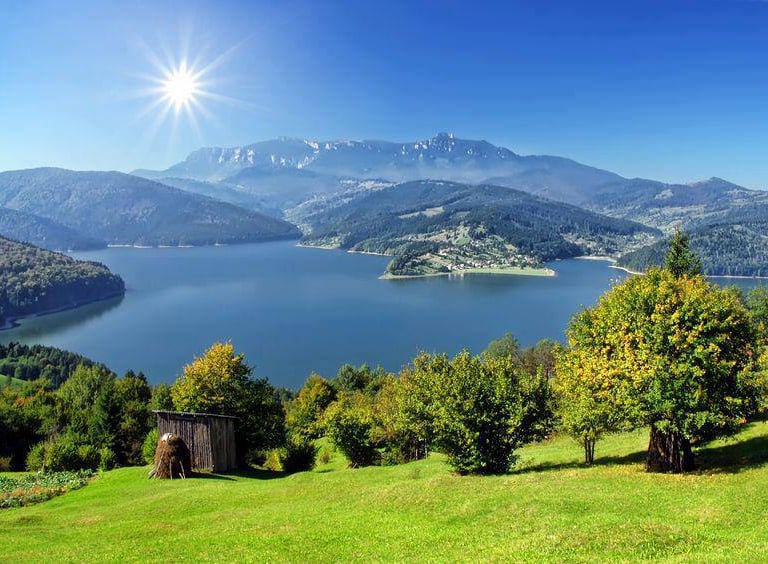
Physical features
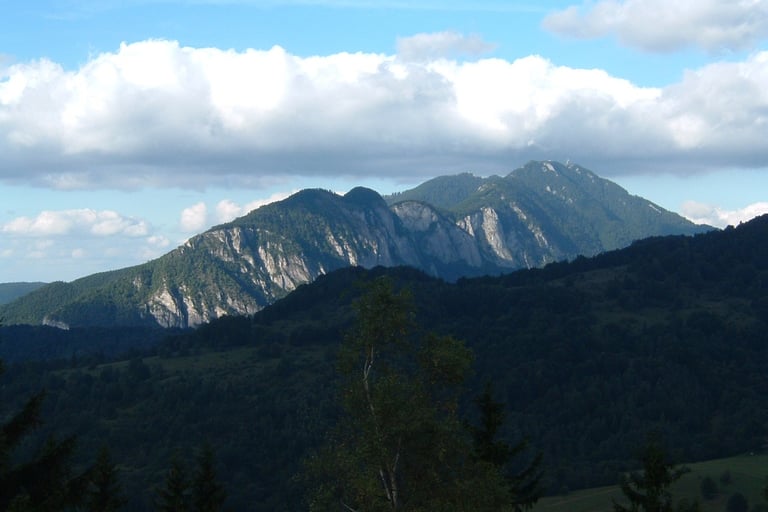
Mountains: 31% of Romania’s territory
Hills and orchards: 36%
Plains: 33%
Areas covered by rivers & lakes: 3.7 %
Total number of lakes: 3,500 - Lakes greater than 250 acres: 300
Highest mountain peak: Moldoveanu Mt. - 2544 meters
Climate
Romania has a temperate climate, similar to the north-eastern United States, with four distinct seasons.
Spring is pleasant with cool mornings & nights, & warm days.
Summer is quite warm, with extended sunny days. The hottest areas in summer are the lowlands in southern & eastern Romania where 30°C is often reached in July & August.
Temperatures are always cooler in the mountains.
Autumn is dry & cool, with fields & trees producing colourful foliage, much like New England.
Winters can be cold, especially in the mountains. While not the rule, abundant snowfalls often occur throughout the country, from December to mid-March.
Hottest month: July Coldest month: January.
Geographical Location
Romania is situated in the south-eastern part of Central Europe & shares borders with Hungary to the north-west, Serbia to the south-west, Bulgaria to the south, the Black Sea & Ukraine to the south-east & to the north & the Republic of Moldova to the east. Romania is the second largest country in the area, after Poland.
Romania extends approximately 480 kilometres North to South & 640 kilometres East to West. Romania's territory features splendid mountains, beautiful rolling hills, fertile plains & numerous rivers & lakes. The Carpathian Mountains cover the centre of the country bordered on both sides by foothills & finally the great plains of the outer rim. Forests cover over one quarter of the country and the fauna is one of the richest in Europe including bears, deer, lynx, chamois & wolves. The legendary Danube River ends its eight-country journey through Europe at the Black Sea by forming one of the biggest & most interesting wetlands in the world, the Danube Delta.